Monday, 9 February 2015

2014 in wildlife: January-June


Above: sanderlings at Rossall Point, Fleetwood, Lancashire

It's been a mixed year. The first half was spent between Scotland and Lancashire, and that's how I expected it to continue. But midsummer health and technology upsets meant I spent almost all the rest of the year at home, and some plans didn't amount to anything. Having said that, I've seen quite a few new bird species, and taken a few photographs. Here's a quick summary of the first six months (I've split the year as there are a lot of pics), garnished with some of my favourite shots.


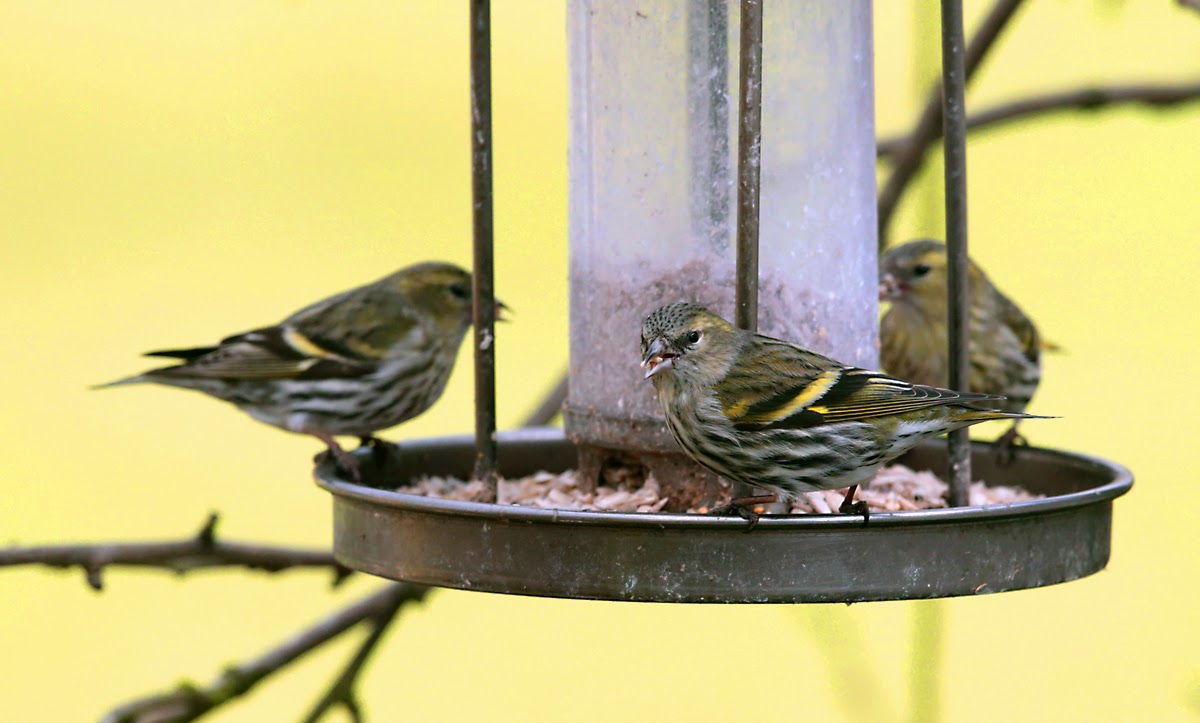
Above: a male shoveler at Stanley Park, Blackpool; below: siskins in West Lothian.


Having two 'home' locations has many advantages for wildlife spotting, especially when they are as different as these. One coastal, low-lying, with extensive sandy beaches and dunes, mudflats, tidal estuaries, and open farmland nearby; the other hilly, inland, with lots of woods and upland rivers. I also got out to a couple of other locations, Nottingham and London, although the wildlife in these places was of limited, personal interest.


Above: grey wagtails, resident at Stanley Park (winter and spring); below: a female in breeding plumage, West Lothian.


It was a mild and wet winter mostly, with a pretty good spring and plenty of heat in the middle of summer. I was more focused on particular species at particular sites, in addition to my usual wandering. But as ever, luck played a big part in what I saw.


Spring warblers were a target. Above: a willow warbler; below, a chiffchaff, both in Blackpool (IDed based on song, you'll have to take my word for it). 


Due to computer problems, I don't have access to the full back catalogue of photos, nor to proper editing, so I've had to cobble together this as best I can. My Flickr feed has a lot of these shots, but I've also tried to find a few unpublished ones on memory cards and rescued from my defunct laptop's hard drive.


Above: Almondell & Calderwood Country Park in West Lothian is a great location. Dippers on the river, bullfinches in the local hedgerows - I've yet to see their kingfishers.

 Below: Fleetwood in Lancashire is a surprisingly good place for birds. Rossall Point catches lots of passage migrants, both rare and common (here's one of the latter, a meadow pipit), and proved a good spot for one of my top targets, stonechats (below); while Fleetwood Marsh Nature Park is a hidden gem, packed with good birds, like this wheatear and skylark - so long as you can stand the incessant wind and obnoxious dog walkers.


I mostly attained my goals - I photographed numerous skylarks, including during their song flights, wheatears, finches, and other assorted passerines. Larger birds were less successful, but that's something I can work on in 2015.


Above: it took me years to get a good goldfinch shot. They may be common and widespread, but they are unexpectedly picky about where they land.

Sunday, 1 February 2015

Birds of January

 Bird of the month: the elusive but beautiful firecrest.

This year I'll keep track of the total number of bird species I encounter, as well as new ones. Unlike my previous lists, this can include things I see or hear with confidence but don't photograph. It's easier to tot them up monthly, so here's the first tally. My original year target was 150, based on what I've managed before, but given how much progress I've made already, I might raise that later on. I've underlined "lifers", i.e. species I've never seen before.

January 2015
95 species (6 lifers)
Bar-tailed godwit
Barnacle goose
Black-headed gull
Blackbird
Bluetit
Bullfinch
Buzzard
Canada goose
Carrion crow
Cetti's warbler
Chaffinch
Coal tit
Collared dove
Common gull
Coot
Cormorant
Curlew
Dunlin
Dunnock
Eider
Feral pigeon
Fieldfare
Firecrest
Gadwall
Golden plover
Goldcrest
Goldeneye
Goldfinch
Goosander
Great black-backed gull
Great crested grebe
Great grey shrike
Great spotted woodpecker
Great tit
Greenfinch
Grey heron
Grey plover
Grey wagtail
Greylag goose
Herring gull
House sparrow
Iceland gull
Jackdaw
Kestrel
Lapwing
Lesser black-backed gull
Linnet
Little egret
Little grebe
Long-tailed tit
Long-eared owl
Magpie
Mallard
Meadow pipit
Mediterranean gull
Merlin
Mistle thrush
Moorhen
Mute swan
Oystercatcher
Peregrine
Pheasant
Pied wagtail
Pink-footed goose
Pintail
Pochard
Purple sandpiper
Red-legged partridge
Redshank
Reed bunting
Ringed plover
Robin
Rook
Sanderling
Shelduck
Shorelark
Shoveler
Skylark
Snipe
Sparrowhawk
Starling
Stonechat
Teal
Tree sparrow
Treecreeper
Tufted duck
Turnstone
Twite
Water rail
Whooper swan
Wigeon
Woodcock
Woodpigeon
Wren
Yellowhammer

 Runners up: flocks of twite livening up the saltmarshes.

Wednesday, 28 January 2015

Sniping, shriking, and... skewering?


It's been a busy couple of weeks, despite setbacks. I went back to Marton Mere as it's close and one of the species I have missed numerous times (little owl) was seen there again. Of course it was nowhere to be seen, but I did photograph the Iceland gull that winters here - although I had my backup camera and it was set to small jpeg, so the photos aren't worth posting here. A male stonechat was nice to see, too.


I injured my knee last Wednesday/Thursday, and that has been a problem for someone who walks everywhere. It was sunny on Saturday, and I felt well enough to try a long walk, taking in several local spots I've not visited recently. I took the train a short distance to catch the high tide flushing waders - especially jack snipe. But I was at the wrong end of the patch, due to confusion on my part, and only saw regular snipe. But they were nice enough - seeing one on the ground is a rare thing round here (see photo above - unfortunately the one that was in focus wasn't well posed).


At the nearby manmade lake, I scouted for the male scaup that has been there on and off for a few weeks (I saw it in December), but it was absent - one was seen a little further round the coast that day though. I did find a little egret huddled out of the strong, cold wind, which is not a species I've seen there before (though they are found on the salt marshes regularly).

My first greenfinch of the year in a garden, before I found a church that hosts peregrines. Was the pair of dark wings I could see high up one of them? Sadly I got no definitive shots, but despite scepticism from David M and David C, I can't see what else it could be - not a gull, not a pigeon, surely not an oystercatcher. I will go back when the light is better (I was shooting a shady wall into the sun).

Is this a peregrine? Anyone??

I finished by heading to the edge of St Anne's, where a great grey shrike has been attracting visitors for three months now. I had to add it to my year list, but the one birdwatcher/photographer I found there hadn't seen it despite an hour of waiting. We enjoyed a perched female(?) kestrel, which I later saw hunting in the next field. Then a wagtail came over - but the other fellow correctly identified it as the shrike (in my defence, they're both black and grey/white, long-tailed, and bobbing in flight). Fortunately, it landed in front of us, and though it moved around a bit, posed well - if a little distantly. I got several reasonable shots at least.


I had overdone it though - 7.5 miles' walk on a dodgy knee (and my other leg wasn't too good either). The following day was overcast and chilly, and rain was forecast, so I had no plans. But then David M offered me a lift to a patch that's hard to reach without a car, to look for another local celebrity, a juvenile pomarine skua that has been seen daily for a couple of weeks or more. Too good to miss.

 Above: the Med gull is the one without black on its wing tips. Argh! Below: twite, on the ground and in the air.


We visited a great many places by my standards, one twice (Cocker's Dyke, the suggestively-named outlet for one of the local drainage ditches). It was a superlative day for birds - I saw at least 15 new year species, and two lifers. However, the light was poor, the wind strong and cold. It seemed, however, that all the birders on the Fylde were there - including David C, who I met for the first time. No skua - it was more mobile than people had feared, as it's been injured. However, my first ever Mediterranean gull (thanks to David M for the ID - I wouldn't have stood a chance!) and merlin, which was way too fast for a photo. My highlight of the day has to be the twite, however - a big flock of these lovely finches fed very close to us, and flew around giving good views for some time.

Not native, but lovely and hard to get close to - a red-legged partridge. Note the tree sparrows in the foreground. This was taken from the cover of a car.

Sunday, 18 January 2015

Third time lucky


A mostly sunny afternoon, and the gales had died down - one last attempt at the firecrest was necessary. I was encouraged by David M's discovery of an even rarer bird at the reserve on Friday, a dusky warbler - which had somehow mistaken Lancashire for its usual wintering grounds of Southeast Asia. In addition, there was the chance our wintering Iceland gull would be there, as it spends some time at the mere when it's not foraging for scraps at a local waste processing plant. Plenty of chances then.

I've rotated this photograph to show the bird more clearly - it forages vertically, as in the photo at the top.

The one downside was my camera's low battery. I stupidly left the charger in Scotland, so am eking out the remaning charge while I sort out getting a replacement - fortunately the 5D mark III can last well over a week on a single charge, even with moderate usage (though using it for video is another matter entirely). I knew I'd have to ration my shots, so no photographing common species, unless they were posing especially well.


My first views - a pity the in flight shot was misfocused.

Well in fact I did see lots of lovely common birds the moment I entered the park, on the way to the reserve. A proper winter 'mixed tit' flock - long tails, chaffinches, great tits, goldfinches, and a great spotted woodpecker, working their way slowly alongside my path. The woodpecker gave great views, until I got my camera out, when it retreated to higher branches. But a treecreeper appeared, and fed low down and close by, and I got my best shots ever of this species (see above).


I sped over to the firecrest's haunt, and found a solitary bird watcher, who had been waiting patiently for some hours. While he ate a sandwich, I noticed a flock of long-tailed tits (the fourth flock I'd seen since leaving the house). The firecrest sometimes hangs around with these other birds, so I wandered up the path to look. And at last, one of the birds was my quarry. I got a few shots, but lost it when I beckoned the other man over. It reappeared closer, and worked slowly and methodically through the brambles towards the mere. Many other people arrived, and watched it, but I'd already got the shots I wanted, so I left soon after - they stood hoping it would reappear, but I'm not sure it did.


On a high from this, I decided to spend a lot of time looking for the warbler - nobody else had seen it that day, despite the area's best bird folk searching for hours. The light was good, and I had plenty of time, so I decided to be as thorough as I could. To cut a long story short, I didn't find it and neither did anyone else. I also missed the long eared owls, but I've seen one already this month. I did see a treecreeper - which is apparently an exceptional rarity on the reserve - and more exciting to me, a water rail feeding under shrubs, only my third sighting ever.


The one serious birder I told about this find was distinctly unimpressed - their loss!

Finally, I came to the far side of the patch, and saw a lovely female stonechat. It posed wonderfully, first on a hawthorn, then on dry grasses, and I got plenty of good shots between passing shower clouds, of which I've included a selection here. The temperature dropped towards sunset, I got caught in a heavy hailstorm, and I lost my gloves (but got them back today), but I was more than happy with the day. More like this please!