Saturday, 2 November 2013
Bird project 27 - Yellowhammer
27/101.
Emberiza citrinella Yellowhammer
Location: Hedgerow beside Union Canal, south of Broxburn, West Lothian, Scotland.
Conditions: Cold, very strong, gusty wind; sunny spells.
Photograph quality: 1.
Comments: Not long after arriving in Scotland, I saw my first new species of the month. I wasn't expecting to see these birds at all, although they are fairly common and widespread. As it turned out, I saw them several more times during my stay, and a small flock even ventured into the garden at one point. Very exotic-looking birds.
Wednesday, 25 September 2013
Bird project 26 - Sandwich tern & rock pipit
26/101.
Sterna (syn. Thalasseus) sandvicensis Sandwich tern
Location: Rossall beach, Fleetwood, Lancashire.
Conditions: Mild, light breeze, mostly cloudy; a couple of hours after high tide.
Photograph quality: 1-2.
Comments: I wasn't expecting to see this species yesterday, but I was not surprised either. They've been sighted in numbers around the coast here quite a lot in the last couple of weeks - habitually roosting at Knott End just round the coast, and even a few a mile or two south of Blackpool town centre.
I was actually stalking another bird - a tiny wader, that is probably a dunlin (I haven't yet identified it), when I realised immediately in front of my was a pair of terns on the sand, alongside a slightly larger and chunkier black-headed gull. I knew straight away it was a sandwich tern - they're pretty distinctive (only common and Arctic terns are otherwise found round here, and they look quite different). These birds winter in Africa, so I was glad to catch them before they leave.
One was an autumn plumage adult (not the paler forehead - it would be black in the breeding season), the other a juvenile. The latter bird was very noisily begging for food, adopting a posture reminiscent of gulls - hunched, the beak upturned and open. The adult seemed oblivious. They flew off a few metres along the beach every so often, but I was able to get quite close. See also my best shots here and here.
27/101.
Anthus petrosus Rock pipit
Location: Sea defences at Rossall Point, Fleetwood.
Conditions: Late afternoon, cloudy, mild, light breeze.
Photograph quality: 1.
Comments: This is a little less certain than my previous species. This little bird landed on a concrete buttress just by me, and didn't mind me creeping closer to photograph it. But its identity was only established on iSpot, a website where you can post wildlife sightings for identification. Two people agree it is a rock, not meadow pipit, but I am not able to say for sure myself - it seems to be a juvenile, given its yellowish, dull appearance, and these species are hard to separate at the best of times.
However, a rock pipit was seen by birdwatchers there on the same day, although it was outnumbered 8-1 by meadow pipits, and it was in the right habitat, so I am including it here.
Thursday, 19 September 2013
Bird project 25 - Ruff
25/101.
Philomachus pugnax Ruff
Location: Levenhall Links natural reserve, East Lothian, Scotland.
Conditions: Warm, humid, sunny spells but plentiful cloud, late afternoon.
Photograph quality: 2-3.
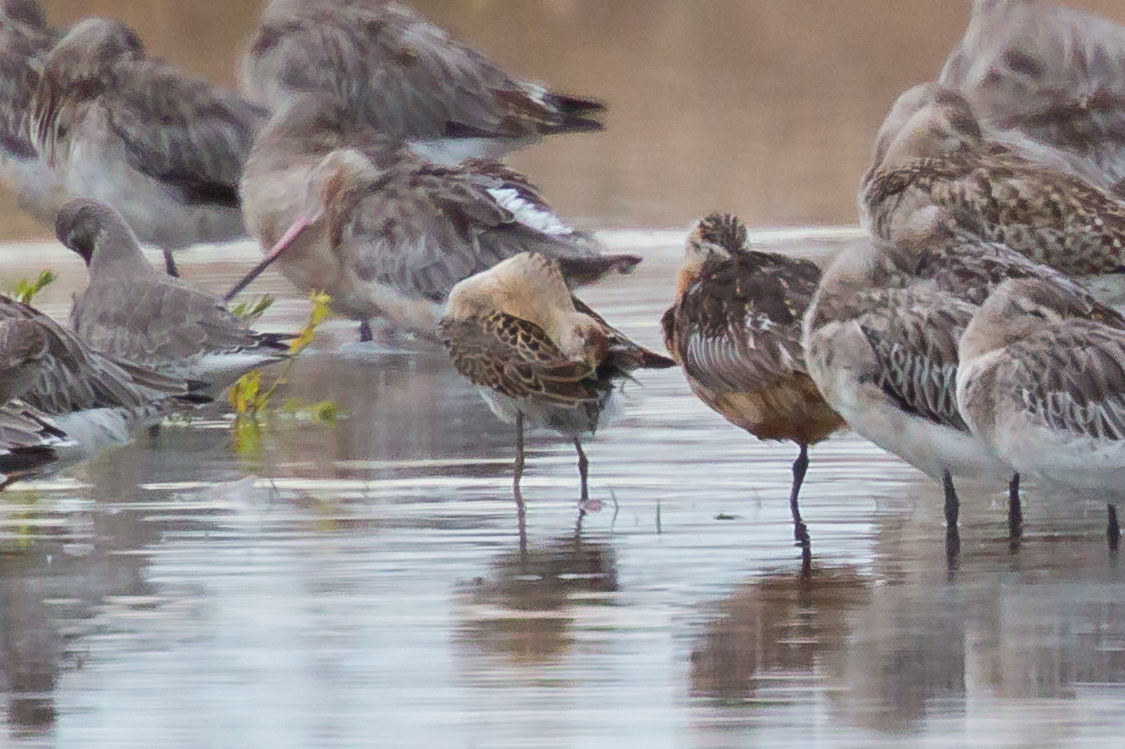
Comments: This should be number 23 chronologically, but I only realised I had a potential shot of a ruff yesterday, when I finally started going through all my photographs from Scotland systematically. There was always a chance I'd captured one - I took lots of pictures of the assemblage of large waders while I was at this location, as I knew a couple of ruffs were there, but they weren't visible at the time I reached the second hide.
I noticed one bird that was slightly smaller than the godwits around it, and although its head is at awkward angles, in the first shot you can see its beak, which is much shorter than these other birds'. iSpot, a website where wildlife sightings can be identified and double-checked, returned a massive positive confirmation - including a response from the British Trust for Ornithology, so I can add this to my list of confirmed sightings.
I'd love to see a ruff more clearly, especially in breeding plumage, but that will have to wait until next year. Anyhow, I'm a quarter of the way to my goal, which is pretty good.
Saturday, 14 September 2013
Bird project 24 - Wheatear
24/101.
Oenanthe oenanthe Wheatear
Location: Sea defences, North Shore, Blackpool.
Conditions: Warm sunshine, cool persistent breeze, very thin high cloud.
Photograph quality: 1.
Comments: I walked north from the town centre specifically to look for these birds, which have been reported here in the last few days. They'll be returning to Africa soon, so I wanted to catch them. I wasn't quite sure where to look, but I kept my eyes and ears open - but since I hadn't managed to get out as early as I wanted, I wasn't expecting to be lucky.The tide was out, so the huge expanse of beach hosted the usual birds - scattered flocks of several gull species, the occasional crow, a few oystercatchers, and on a patch of rocks, turnstones. On the 'cliffs' (artificial outcrops between the Promenade and the beach) was a single pied wagtail, and above a lone swallow was feeding. I turned back home.
But then, back towards town, I saw a bird on the steep slope below (there are three levels you can walk on, I was in the middle). It was immediately obvious this was my target - a warm buff-coloured bird, bobbing and feeding amongst the tufty plants. I edged closer, and it continued its business, allowing me to get a couple of hundred shots, mostly pretty good.
I assumed it was a female (the adult males are more strikingly marked), but it was identified as a first-year bird, so could be either sex (autumn wheatears in general are hard to distinguish).
Sunday, 25 August 2013
Bird project 23 - Dipper
23/101.
Cinclus cinclus Dipper
Location: Rocks on the Almond River, by Nasmyth Bridge, Almondell & Calderwell Country Park, Lothian, Scotland.
Conditions: Mostly cloudy but bright, mild, calm.
Photograph quality: 2 (borderline 1).
Comments: I took my parents to this lovely country park, as they live nearby and it's a great spot for tranquil walks by the river and in the woods. I had my bird lens on me, but didn't expect to see anything notable. However, crossing the glorious Georgian/Regency bridge, we all spotted a small brown bird flit across the rocks. I thought a blackbird maybe, until I looked through the camera and realised it was one of the local specialities I'd hoped (but failed) to see on every previous visit. It dipped, and walked through the water, giving us a couple of minutes' viewing, before it disappeared. I had to use longer than ideal exposures, and reached the upper limits of ISO I'm comfortable with for birds on my camera (3200-4000 for some shots), so the fast-moving dipper was often blurred. Still a few shots were okay - even one I was comfortable using on Flickr.
Wednesday, 21 August 2013
Bird project 22 - Whimbrel
22/101.
Numenius phaeopus Whimbrel
Location: Levenhall Links natural reserve, East Lothian, Scotland.
Conditions: Warm, humid, sunny spells but plentiful cloud, late afternoon.
Photograph quality: 2-3.
Comments: I went to this location for something much rarer: a wood sandpiper had been seen here for a few preceding days. But also ruff and whimbrel - so a good choice in general. I had no idea what to expect, as the local bird reports just said 'wader scrape'. I thought it would be a few birds, out of the way. How wrong I was. Signposts were abundant once I found the site, and its importance was clearly understood. The hides were made of brick, and a local birdwatcher (I suspect one of the people who updates the website) was friendly, and he (and his friend who soon arrived) helped me - as there were hundreds of birds. When four whimbrel flew in, they noticed immediately, and I got a couple of unfocused shots in flight. The birds stayed longer than I did, so I got a few good shots, although they were quite distant. Note the striped heads, about the best visual clue to this species - many similar, far commoner, curlews were present nearby.
Thursday, 11 July 2013
Bird project 21 - Little grebe
21/101.
Tachybaptus ruficollis Little grebe
Location: Middle of north section of Stanley Park lake, Blackpool.
Conditions: Very warm, bright, some light cloud, very light breeze. Mid-afternoon.
Photograph quality: 2-3.
Comments: These birds are resident, albeit in small numbers, in my area, but are rarely found in the park. I heard them calling at Fleetwood Marsh nature park back in the spring, but they never came into view. I also visited Marton Mere a few times, hoping to see them, but never succeeded.
I think part of the problem is, they are much smaller than I realised. I scanned the park lake yesterday, setting up my camera at various points around the shore. Only at the fifth location did I see them - and even then, only after a long time looking. They were right in the middle, seemingly attempting to sleep amid the floating vegetation. Ducks were feeding around them - these are mallards, and make a useful scale comparison. The little grebes are scarcely larger than the ducks' heads!
It's nice to have seen them in their more colourful summer plumage. Sadly, even at the longest focal length I can muster (2800mm), they were small in the frame. So record shots only.
Subscribe to:
Posts (Atom)